
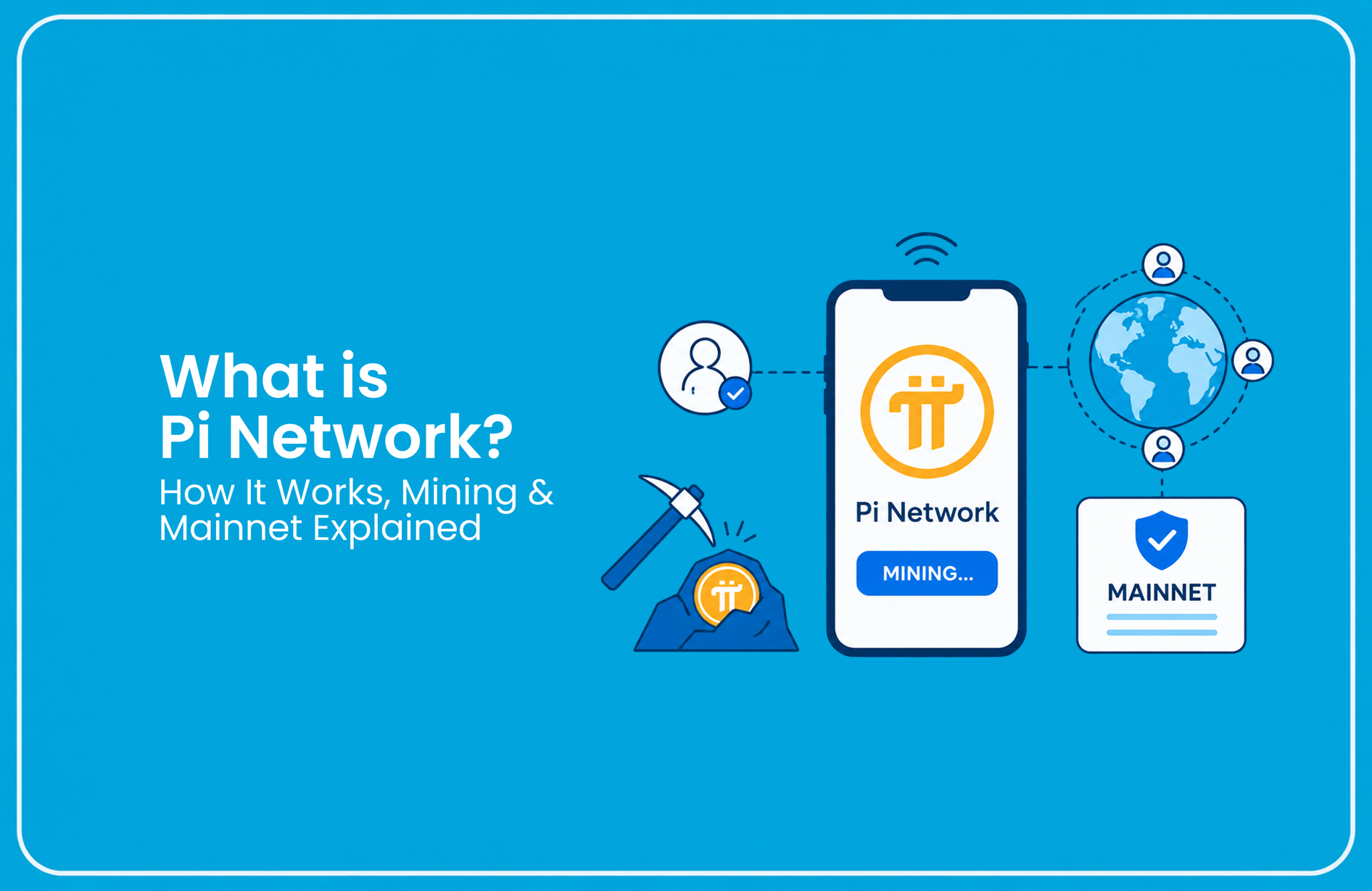
Crypto mining once demanded immense computational power and costly hardware. That changed in 2019, when a team of Stanford graduates built a mobile-first alternative to lower the barrier to entry. If you are asking what is Pi Network, it is a novel concept that lets users mine cryptocurrency straight from their smartphones.
People often ask what is Pi Network and how does it work. At its core, it is a digital currency project that makes crypto reachable for everyday users through a lighter, mobile-friendly consensus mechanism. This guide walks through the ecosystem, the mining process, and the latest on the Pi Network mainnet.
How Does Pi Network Mining Work?
To grasp how does Pi Network mining work, you have to look at how the project secures itself. Rather than raw computing power, the network leans on user engagement and social trust. Its underlying infrastructure runs on the Stellar Consensus Protocol (SCP), a blockchain technology that reaches agreement through a federated Byzantine model, with trust flowing from a web of known participants. Because the algorithm lets ordinary phones help secure the ledger without a heavy energy drain, the whole model stays remarkably sustainable.
Earning Pi Coin
You download the app and tap a button once every 24 hours, and that single tap proves you are human and actively taking part. It is the main way coins accumulate. As the user base hits set milestones, the mining rate halves, a deflationary move that protects scarcity. Early adopters mined at far higher rates, whereas a new user today earns only fractions of a token each day.
Referral System
Joining means using an invitation code and forming a “Security Circle” of three to five trusted members. Invite people to your referral team and your base mining rate climbs. The algorithm reads these interlocking circles to gauge trust across the wider user base.
Node Participation
Users who want to contribute beyond the mobile app can take the next step and run a desktop node. Node operators validate transactions and help keep the decentralised ledger healthy. The network asks operators to update their software regularly, as the recent push to Protocol v25 showed. Running a node now earns you a multiplier on your standard mining rate, and it positions you for future validator incentives.
What is Pi Coin?
It is the ecosystem’s native cryptocurrency, built to power peer-to-peer transactions and Web3 applications. For now, it lives mostly as an accounting unit inside the app for unverified users, and as a real token on the enclosed blockchain for anyone who has cleared Know Your Customer (KYC) identity checks.
Total supply is capped at 100 billion tokens. A large share goes to community mining rewards, while the remainder is split between the core team, liquidity pools, and foundation reserves. The end goal is to become a medium of exchange for everyday goods and services.
Pi Network Mainnet and Current Status
How Pi Network works today comes down to its phased rollout, which moves steadily from a test environment towards a fully live blockchain.
Open vs Enclosed Mainnet
The network currently sits in an “enclosed mainnet” phase, where the blockchain is live but firewalled. Verified users can send tokens to one another and buy goods inside the internal ecosystem, yet they cannot move balances out to external wallets or third-party platforms. The much-awaited “open mainnet,” keeps slipping. External access will arrive only after specific milestones land, chiefly mass KYC verification and a solid set of internal utility apps.
Exchange Listing Status
Since the network stays enclosed, official tokens cannot trade on public cryptocurrency exchanges. Any “Pi” or “Pi IOU” listing you spot on tracking sites or smaller exchanges is an unauthorised IOU running on pure speculation. The core team warns flatly against trading these IOUs, because nobody can deposit or withdraw them until the open mainnet officially launches.
Trade Crypto Without the Wait on Shark Exchange
While enclosed networks finish launching, you can trade established cryptocurrencies today. Shark Exchange is India’s lowest-cost crypto exchange offering advanced F&O trading.
- INR-Native Trading: Deposit and withdraw directly in Indian Rupees. No stablecoin conversions and no forex hassles.
- Unmatched Fees: Benefit from a 0.016% Maker Fee and 0.040% Taker Fee.
- High Leverage: Trade Bitcoin, Ethereum, Solana, and other perpetual futures in INR with up to 150x leverage. No crypto ownership is required to profit from price movements.
- Flexible & Secure: Trade without expiry dates. Our FIU-registered platform ensures bank-grade security, 2FA, and end-to-end data encryption.
Benefits and Use Cases of Pi Network
Strip out the pricey hardware and the project suddenly onboards millions of people who were locked out of the cryptocurrency sector before. That is precisely what has happened. The network has since spawned commerce applications, Web3 payment integrations, and decentralised identity infrastructure. Subscription-based smart contracts on the testnet hint at deeper decentralised finance (DeFi) capabilities to come. The aim is a closed-loop economy in which the token natively pays for goods, services, and developer tools.
Risks and Limitations of Pi Network
Centralization Concerns
The core team keeps tight control over the codebase, the KYC process, and the network’s transition timeline. Its invitation-only model has drawn comparisons to multi-level marketing (MLM) structures, although nobody is required to invest fiat currency to take part.
Delays and Adoption Challenges
The long enclosed mainnet period bottlenecks primarily on KYC. Without verified identities, users simply cannot migrate their mobile balances to the blockchain. Until the open mainnet goes live, the token carries no verifiable external market value. When it does launch publicly, that vast circulating supply could trigger intense selling pressure as early adopters rush to cash out.
Is Pi Network Worth Exploring?
Downloading the app costs nothing, so your real risk is just your time and the personal data you hand over during the KYC process. The ecosystem’s true worth will be tested only once the open mainnet is live and the token meets free-market dynamics.
Understanding Pi Network with Shark Exchange
In answering what is Pi Network, it stands as one of the largest experiments in mobile-first digital currency. By leaning on the Stellar Consensus Protocol and a distinctive social trust mechanism, it has grown a user base that rivals established top-tier blockchains. The continuous delays and stringent KYC requirements are undeniably frustrating. Even so, ongoing technical upgrades such as node protocol advancements and smart contract deployments point to sustained development. It could succeed as a global medium of exchange or buckle under market pressure at its eventual open launch.
FAQ – Pi Network
1. Is Pi Network free to join?
Yes. Joining Pi Network is free. Users can download the app, create an account, and begin mining Pi without purchasing mining equipment.
2. Can I sell my Pi coins right now?
Pi coins can only be traded according to the network’s current mainnet rules. Users should avoid unofficial Pi IOU listings that are not supported by the Pi Network.
3. Do I need KYC verification to use Pi Network?
Yes. KYC verification is required to migrate your mined Pi to the mainnet and access many features within the Pi ecosystem.
4. Does Pi Network consume a lot of battery or mobile data?
No. Pi Network is designed to be mobile-friendly and requires minimal battery power and data compared to traditional cryptocurrency mining.
5. Is Pi Network a real cryptocurrency?
Pi Network has its own blockchain and native token, but its broader utility and market value depend on the ongoing development and adoption of its open mainnet ecosystem.
6. What can I do with Pi coins?
Verified users can use Pi coins within the Pi ecosystem for supported transactions and applications. Broader use cases may expand as the network continues to develop.
7. Is Pi Network a good investment?
Pi Network is still evolving, and its future value remains uncertain. Before participating, consider its development progress, adoption, and associated risks, and do your own research.