
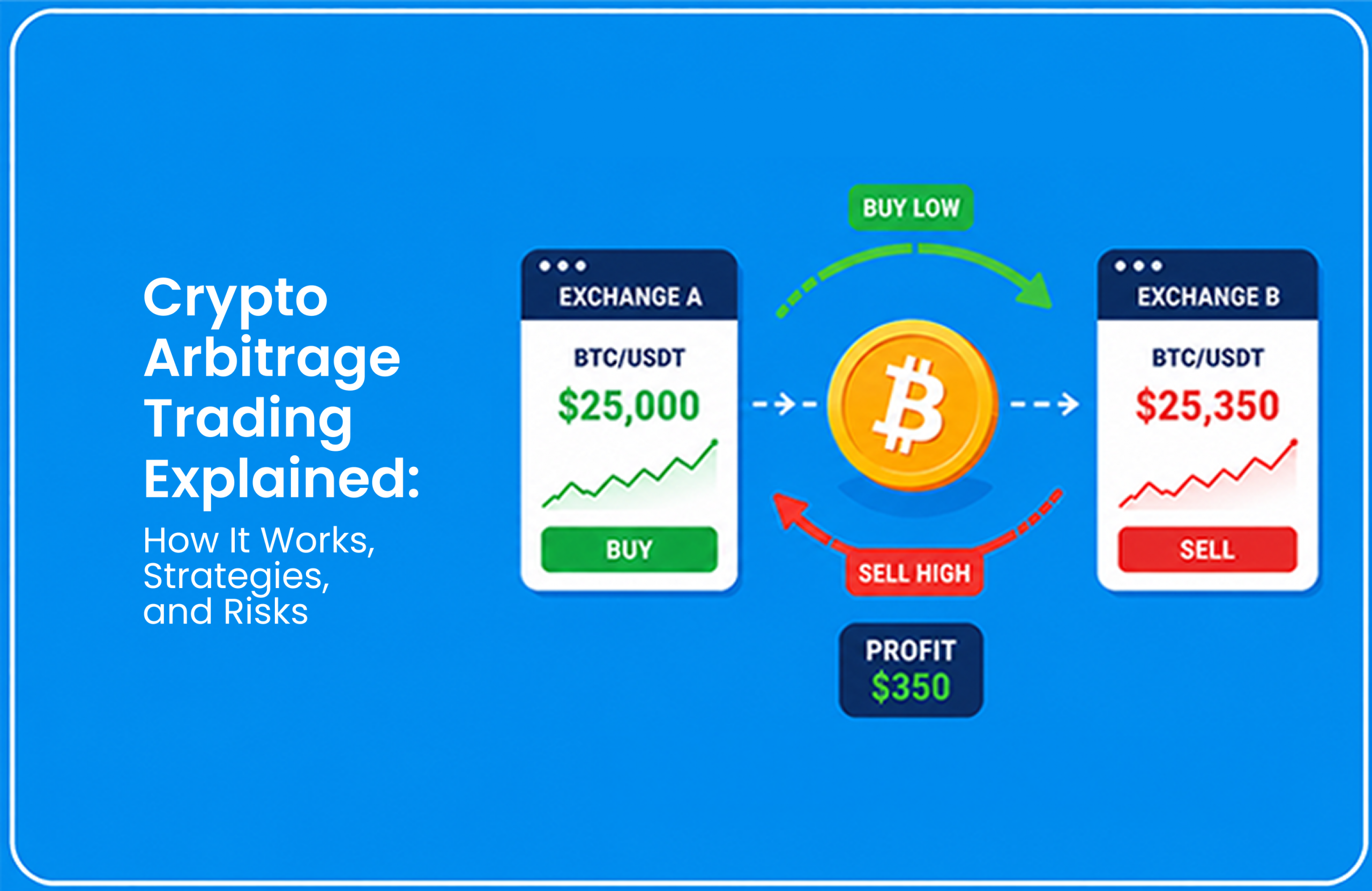
Most watch the digital asset market’s wild price swings with dread. Savvy market participants? They see a mathematical certainty. Capitalising on these constant inefficiencies forms the bedrock of crypto arbitrage trading. Rather than gazing into a crystal ball to predict where Bitcoin heads next, this approach harvests immediate price discrepancies for the exact same asset across distinct platforms.
What is Crypto Arbitrage Trading?
Let us strip away the jargon: what is crypto arbitrage trading, practically speaking? It involves snapping up a token on an exchange where it trades cheap, then instantly offloading it on another platform flashing a higher valuation.
Arbitrage in cryptocurrency thrives on fragmentation. Traditional stock markets rely on heavily centralised pricing. Crypto does not. Supply and demand dictate localized valuations across hundreds of disconnected order books. These isolated ecosystems frequently fall out of sync, creating fleeting windows to extract pure profit.
How Crypto Arbitrage Trading Works
If you are researching how to do arbitrage trading crypto, speed and deep liquidity remain your primary hurdles. We aren’t hunting massive, multi-day trends. We are chasing razor-thin, ephemeral spreads.
Imagine Bitcoin sits at $60,000 on Platform A but nudges $60,200 on Platform B. You buy the 1 BTC on A, dump it on B. Subtract your withdrawal tolls and trading levies, and you pocket the remainder. Sounds simple enough. Yet, automated algorithmic bots now dominate crypto arbitrage, turning manual execution into an uphill battle against machines operating in milliseconds.
Types of Crypto Arbitrage Strategies
Market operators generally deploy two distinct architectures to trap these pricing anomalies:
Exchange Arbitrage
This represents the classic crypto coin arbitrage playbook. Funds shuttle between two entirely separate venues. A popular variant involves spatial gaps—perhaps Korean exchanges suddenly price Ethereum 2% higher than European counterparts due to localized regulatory news or fiat bottlenecks.
Triangular Arbitrage
Here, capital never leaves the original exchange. You hopscotch between three distinct assets. Trade BTC into ETH, swap that ETH for SOL, then funnel the SOL right back into BTC. Should the internal order book ratios misalign, that final conversion deposits slightly more Bitcoin into your wallet than you started with.
Crypto Arbitrage Opportunities and Challenges
Spotting lucrative crypto arbitrage opportunities demands sharp market surveillance tools and robust capital distribution. Unearthing genuine gaps often pushes traders toward P2P trading hubs, where individual sellers occasionally list assets wildly divorced from spot market realities.
Guides tackling crypto trading for beginners frequently frame this discipline as a “low risk” entry point, mainly because it strips out directional market guessing. The true friction? Margins shrink daily. Institutional titans constantly stalk these spreads, snapping them shut instantly. Beating them means parking idle capital across multiple platforms to bypass sluggish on-chain network confirmations.
Risks in Crypto Arbitrage Trading
Do not let the “risk-free” label fool you; that myth sits high on the list of fatal crypto trading mistakes. Several factors can rapidly incinerate an arbitrageur’s profit:
- Slippage: Order books dry up. The spread evaporates before your bid fills, leaving you holding the bag at a loss.
- Network Congestion: Blockchains congest. Moving tokens takes minutes, but spreads vanish in seconds.
- The Fee Trap: High trading levies ruthlessly devour margins, making cost-effective platforms like Shark Exchange essential.
- Counterparty Danger: Scattering funds across obscure platforms multiplies your exposure to sudden hacks or insolvency.
Unlike heavily leveraged plays where devastating crypto liquidations ruin portfolios, arbitrage relies entirely on unleveraged spot assets. Still, borrowing capital to magnify these fractional gains immediately reintroduces severe liquidation threats if the spread violently widens instead of closing.
Approaching the Craft
Ultimately, mastering this craft offers a structured, math-driven pathway through a chaotic market. Success demands surgical precision, rigorous fee calculation, and an automated setup. While the glaringly obvious spreads of the early days have largely disappeared, the inherently decentralised architecture of digital assets guarantees these pricing fractures will persist. For those trading on Shark Exchange, there remains a consistent, fertile landscape to harvest tangible value from the market’s noise.
FAQ’s – Crypto Arbitrage Trading
1) What is crypto arbitrage trading?
Crypto arbitrage trading is a strategy where traders buy cryptocurrency on one platform at a lower price and sell it on another platform at a higher price to profit from price differences.
2) How does crypto arbitrage trading work?
Crypto arbitrage works by identifying price gaps for the same asset across exchanges and executing quick buy-and-sell trades before the gap closes.
3) Is crypto arbitrage trading profitable?
Crypto arbitrage can be profitable, but profits are usually small and depend heavily on speed, low fees, liquidity, and efficient execution.
4) What are the different types of crypto arbitrage strategies?
The most common strategies include exchange arbitrage between different platforms and triangular arbitrage within the same exchange using multiple trading pairs.
5) Is crypto arbitrage trading risk-free?
No, crypto arbitrage is not risk-free. Risks include slippage, exchange fees, network delays, liquidity issues, and platform security concerns.
6) Can beginners do crypto arbitrage trading?
Yes, beginners can explore crypto arbitrage, but understanding trading fees, transfer times, and market execution is important before starting.
7) Do traders use bots for crypto arbitrage?
Yes, many traders use automated arbitrage bots to detect and execute trades quickly, as price gaps often disappear within seconds.